Pine needles and cedar scale clog gutters faster than falling leaves ever do, and most gutter guards sold in British Columbia in 2026 aren't built to stop them. Best overall gutter guard for pine and cedar needle debris in 2026: micro-mesh guards. Best for heavy cedar needle load on steep roofs: reverse-curve (surface tension) guards. Best budget option: foam insert guards. Best for retrofitting an existing aluminum gutter run: perforated aluminum guards.
- Micro-mesh gutter guards block pine and cedar needles better than any other guard type sold in BC in 2026.
- Reverse-curve guards shed heavy cedar debris on steep roofs but cost more to install than a snap-on retrofit.
- Foam insert guards cost the least upfront but harden with pine sap and need replacing every 2-3 years.
- Brush guards and standard perforated guards let fine needles through the gaps and clog within one wet season.
Why this matters
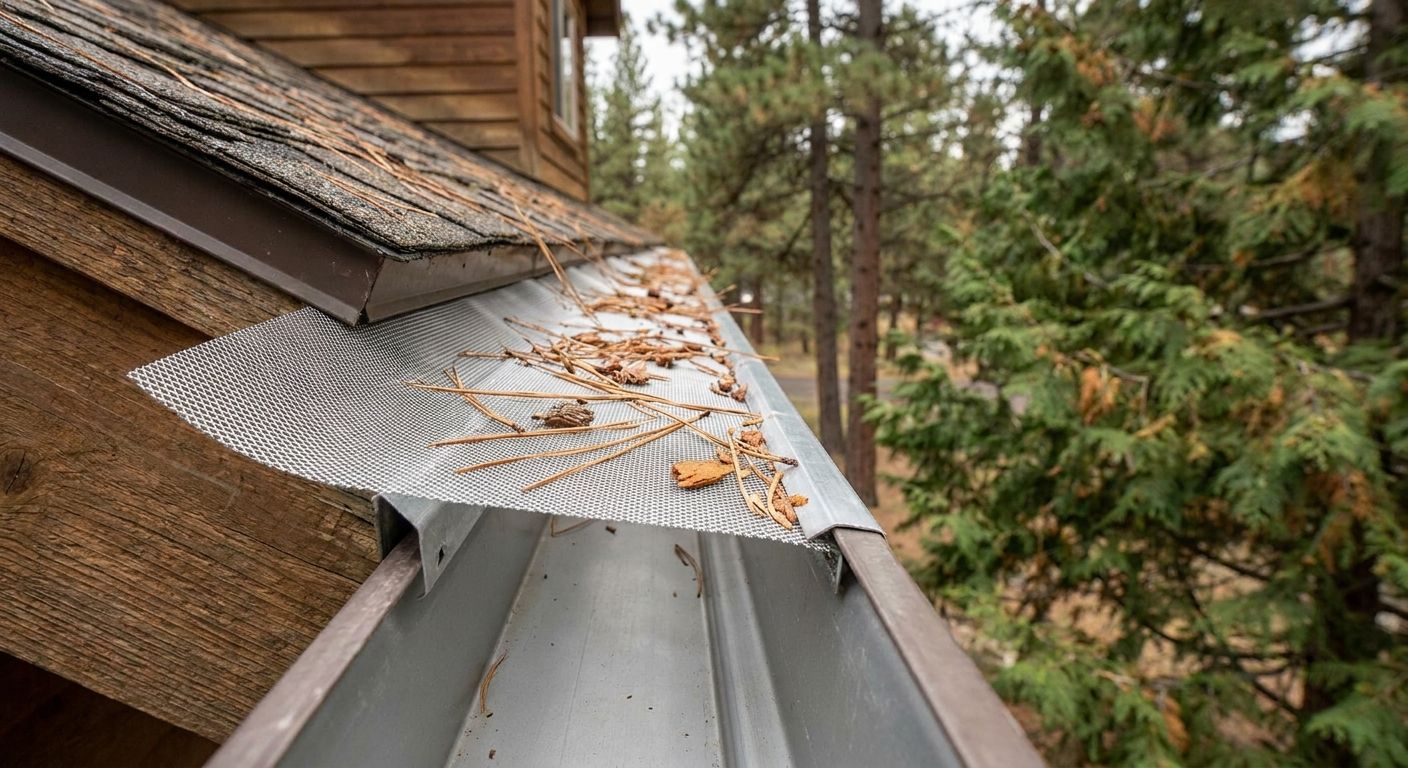
A maple leaf sits on top of a gutter guard and blows off. A pine needle wedges through the gap sideways and stays there, and cedar scale packs into a felt-like mat that holds water against the fascia board.
Coastal BC gets close to 1,200 mm of rain a year, and a gutter that's already half-blocked with needle debris overflows during the first heavy fall storm instead of the third. That overflow runs down the fascia, not away from it, which is exactly the water damage pattern Gutters Canada gets called out for every October.
The guard type matters more than the brand name stamped on it. A wide-gap guard rated for "all debris" on the packaging still fails under mature pine or cedar cover, because the test conditions behind that claim rarely include needle debris at all. If you're still deciding whether a guard makes sense for your property at all, the breakdown in Gutters Canada's guide on whether gutter guards are worth it for BC homeowners covers that question directly.
What makes the best gutter guard for pine needles
- Opening size small enough to stop needles and cedar scale, not just whole leaves
- Sap resistance so pine resin doesn't harden the surface and trap debris in place
- Fit with the existing gutter profile — K-style, half-round, 5-inch, or 6-inch
- Water-shedding capacity during BC's heavy rain events without backing up at the downspout
- Maintenance interval — how many seasons pass before it needs clearing or rinsing
- Installation method that doesn't strip the fascia's screw holes on a retrofit
Gutter guards for pine and cedar needles at a glance
| Guard type | Best for | Standout feature | Key limitation |
|---|---|---|---|
| Micro-mesh guards | Heavy pine & cedar needle debris overall | Openings fine enough to stop needles and grit | Higher install cost; needs occasional surface rinse |
| Reverse-curve guards | Heavy cedar load on steep roofs | Uses roof pitch to shed debris off the edge | Underperforms on low-slope roofs |
| Perforated aluminum guards | Retrofitting an existing gutter | Snaps onto most K-style profiles | Needle clusters mat over the holes fast |
| Foam insert guards | Budget-conscious properties | Lowest cost, no tools to install | Pine sap hardens the foam within seasons |
| Brush guards | Low-slope roofs with light debris | Fastest DIY install | Bristle gaps let fine needles pass through |
1. Micro-mesh guards: best gutter guard for pine and cedar needle debris overall
Micro-mesh guards use a stainless steel or aluminum screen with openings small enough to stop needles, seed pods, and asphalt shingle grit while still passing water. They mount over the gutter's top edge and lock under the shingle line or roof edge flashing.
Micro-mesh guards pros:
- Blocks needle debris that slides straight through wider-gap guards
- Holds shape through BC's wet-dry cycle without warping or bowing
- Fits most gutter profiles, including 5-inch and 6-inch residential runs
Micro-mesh guards cons:
- Costs more upfront than foam or brush guards
- Needs an occasional surface rinse once pine sap and pollen film build up
- A poor install can sag under heavy wet snow load in the Interior
Micro-mesh guards best for: Properties under mature pine or cedar cover shedding needles for months at a stretch. The full comparison in Gutters Canada's leaf guard systems ranked for BC rainfall breaks down how micro-mesh performs against other leaf guard types under coastal rain volumes.
Verdict: Buy.
2. Reverse-curve guards: best for heavy cedar needle load on steep roofs
Reverse-curve, or surface-tension, guards use a solid curved hood that lets water cling to the metal and flow into the gutter while debris rolls off the roof edge under its own weight. There's no mesh surface for needles to clog.
Reverse-curve guards pros:
- Sheds heavy cedar needle drop without a screen to mat over
- Handles steep pitches (6:12 and up) better than mesh options
- Solid metal construction resists ice damming in colder BC winters
Reverse-curve guards cons:
- Underperforms on low-slope roofs (under 3:12) where water doesn't gain enough velocity to curve into the trough
- Installation changes the gutter's front lip, so it's not a bolt-on retrofit
- Fine cedar scale can still wick in during a heavy downpour
Reverse-curve guards best for: Steep-pitched roofs under cedar trees where litter piles up fast between rain events.
Verdict: Buy for steep roofs, skip for low-slope.
3. Perforated aluminum guards: best for retrofitting an existing gutter system
Perforated aluminum guards are flat panels with round or slotted holes that snap directly over an existing K-style gutter, no new brackets required. They screen out whole leaves and larger debris while letting water through the perforations.
Perforated aluminum guards pros:
- Lowest-cost option that still stops full leaves
- Fits over existing gutters without touching the hangers
- Aluminum resists rust in BC's wet climate
Perforated aluminum guards cons:
- Hole size lets needle clusters mat over the surface within one wet season
- Needs manual brushing more often than mesh
- Doesn't stop fine cedar scale as well as micro-mesh
Perforated aluminum guards best for: Retrofits where debris is mostly leaves with only light needle drop mixed in.
Verdict: Hold — fine for mixed debris, weak once pine or cedar dominates.
4. Foam insert guards: best budget option
Foam insert guards are porous foam strips wedged into the gutter channel. Debris sits on top, water filters through the pores, and there's no fastening hardware involved.
Foam insert guards pros:
- Cheapest guard type to buy and install
- No brackets, screws, or fascia work required
- Fits any gutter shape, including box and half-round profiles
Foam insert guards cons:
- Pine sap hardens the foam within a season or two, cutting water flow
- Needles nest inside the pores instead of sliding off the surface
- Needs full replacement roughly every 2-3 years under heavy pine cover
Foam insert guards best for: Short-term coverage on light needle drop, not a long-term fix under a mature pine canopy.
Verdict: Wait — usable as a stopgap, not a real answer to heavy needle debris.
5. Brush guards: weakest option for pine and cedar needle debris
Brush guards are cylindrical bristle inserts that sit inside the gutter trough. Water passes through the bristles while larger debris sits on top.
Brush guards pros:
- Fastest DIY install of any guard type on this list
- Fits round and K-style gutters without modification
- Inexpensive per linear foot
Brush guards cons:
- Bristle gaps let fine needles and cedar scale pass straight through
- Needles catch in the bristles and hold moisture against the gutter metal
- Needs full removal and cleaning more often than mesh or reverse-curve guards
Brush guards best for: Low-slope roofs with minimal tree cover — not pine or cedar debris.
Verdict: Skip for pine and cedar needle debris specifically.
How this ranking was built
Each guard type is scored against the six criteria above: opening size relative to a pine needle (roughly 1-2mm wide), sap resistance, fit with common BC gutter profiles, water-shedding under heavy rain, maintenance interval, and installation method. Micro-mesh wins on the combination of opening size and sap resistance; reverse-curve wins on steep-roof performance alone.
Which gutter guard should you choose for pine and cedar needles?
If you're not sure which way to go, default to micro-mesh guards — they're the only guard type on this list built specifically to stop needle-width debris rather than whole leaves. Switch to reverse-curve only if your roof pitch is steep and cedar litter is heavy enough to bury a mesh surface between cleanings. Skip foam and brush guards entirely if pine or cedar cover is the main debris source on your roof in 2026.
Get your gutters assessed before fall
A site visit tells you which guard type actually fits your roof and gutter profile.
FAQ
What's the best gutter guard for pine needles in 2026?
Micro-mesh gutter guards are the best option for pine needle debris in 2026 because their openings are small enough to stop needles while still passing water. Reverse-curve guards are a close second on steep roofs with heavy cedar litter.
Do gutter guards work with cedar needle debris?
Micro-mesh and reverse-curve guards handle cedar needle debris well; brush guards and standard perforated guards do not. Cedar scale packs into bristle gaps and larger holes faster than it does through fine mesh.
Are micro-mesh gutter guards worth the cost for BC homes?
For homes under mature pine or cedar cover, yes, because the alternative is clearing clogged gutters multiple times a season. For light-debris properties, a cheaper perforated aluminum guard may be enough.
How often do gutter guards still need cleaning with needle debris?
Micro-mesh guards typically need a surface rinse once or twice a year to clear sap film and pollen buildup. Foam and brush guards need clearing far more often once needles nest inside them.
Can I install gutter guards myself over an existing gutter system?
Foam insert and brush guards install without tools over most existing gutters. Micro-mesh and reverse-curve guards usually require fastening under the shingle line, which is where a poor DIY install causes leaks.
What's the difference between reverse-curve and micro-mesh guards?
Reverse-curve guards use roof pitch and water tension to shed debris off a solid hood, while micro-mesh guards physically screen debris out through fine openings. Reverse-curve performs better on steep roofs; micro-mesh performs better on any pitch.
Do brush gutter guards work for pine needles?
No. Bristle gaps in brush guards are wide enough for pine and cedar needles to pass through or catch and hold moisture against the gutter metal, which speeds up corrosion.
How much rainfall do gutter guards need to handle in coastal BC?
Coastal BC gets close to 1,200 mm of rain annually, concentrated in fall and winter storms. A guard that overflows during a single heavy storm is undersized for the region regardless of how well it blocks debris.
One last thing
Pine sap does more damage to a gutter guard's performance than the needles themselves — it's the sap film that turns a clean mesh surface into a debris trap by hardening dust and needle fragments onto the screen. A guard rated for needle debris still needs that sap film rinsed off once or twice a year, or it stops shedding water the same way a clogged one would.