Valley gutters take more water per linear foot than any other run on a roof, and the system you pick there decides whether you get a dry fascia board or a rotted one by spring. Best overall: seamless aluminum K-Style with reinforced valley flashing. Best for commercial and low-slope roofs: EPDM-lined box valley gutter. Best for heritage and high-end homes: copper valley flashing. Best for heavy snow load regions: galvanized steel valley gutter. Best budget option: standard sectional aluminum valley gutter.
- Seamless aluminum K-Style with reinforced flashing is the best overall valley gutters system for most BC homes in 2026.
- EPDM-lined box valley gutters hold up best on low-slope commercial and industrial roofs.
- Copper valley flashing costs more upfront but resists corrosion far longer than aluminum or steel.
- Sectional aluminum valley gutters are the budget pick, but every joint is a future leak point.
- Galvanized steel valley gutters carry heavier snow loads than aluminum in interior BC winters.
“A valley gutter with more than one seam is a valley gutter waiting to leak.”
Why this matters
A roof valley collects runoff from two slopes at once, so the gutter or flashing sitting under it handles two to three times the water volume of a straight gutter run. Get the material or the flashing detail wrong and the failure shows up as a stained soffit, a rotted fascia board, or water tracking into the attic — not as an obvious leak you can spot from the ground.
Homeowners across British Columbia deal with this every wet season, from the coastal rain volume in the Lower Mainland to the heavier snow load valleys see in the interior. The smart thing to do is partner with true gutter professionals who know which valley system matches your roof pitch, your climate zone, and your budget — not just whichever gutter the last crew had in the truck.
What makes the best valley gutters system
- Seam count — every joint is a potential leak point; fewer seams means fewer failure points over time.
- Flashing overlap and underlayment — the metal or membrane under the shingles at the valley matters as much as the gutter itself.
- Material corrosion resistance — aluminum, galvanized steel, and copper age differently under constant water exposure.
- Load capacity — debris, snowmelt, and ice all add weight; the system needs to hold it without sagging.
- Slope-matched design — a valley gutter built for a steep residential roof won't perform the same on a low-slope commercial building.
- Sealant and fastener quality — even the best material fails early if it's hung with the wrong hardware.
Valley gutters at a glance
| System | Best for | Standout feature | Key limitation |
|---|---|---|---|
| Seamless aluminum K-Style (reinforced) | Most residential roofs | Continuous run, minimal seams | Needs correct valley flashing underneath to perform |
| EPDM-lined box valley gutter | Commercial/low-slope roofs | Membrane liner handles standing water | Requires periodic membrane inspection |
| Copper valley flashing | Heritage & high-end homes | Long service life, natural corrosion resistance | Higher material and labor cost |
| Galvanized steel valley gutter | Heavy snow load areas | Rigid, holds weight under ice and snow | Heavier install, can rust if coating fails |
| Standard sectional aluminum | Budget-conscious projects | Lowest upfront cost | Multiple seams, higher long-term leak risk |
1. Seamless aluminum K-Style with reinforced flashing: best valley gutters for most residential roofs
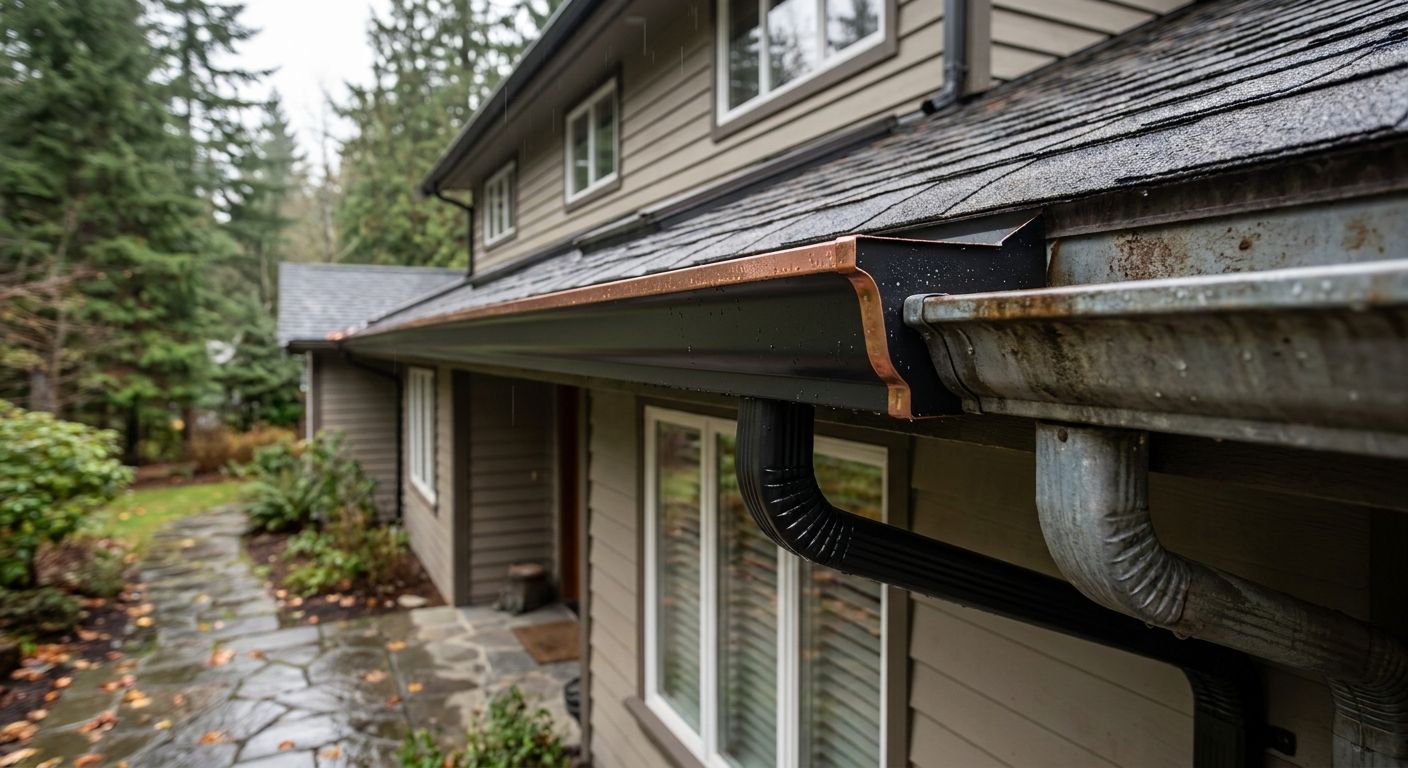
This system is formed in one continuous piece on-site, which cuts the seam count down to almost zero compared to sectional gutters. Paired with a properly overlapped valley flashing detail underneath the shingles, it's the setup most BC residential installers default to for standard-slope roofs in 2026.
Seamless K-Style pros:
- Fewer seams than any sectional system, which directly reduces leak points
- Works with standard K-Style profiles homeowners already have on the rest of the roof
- Fabricated to length, so no mid-run joint sits directly in the water path
Seamless K-Style cons:
- Performance still depends entirely on the flashing installed underneath
- Not rated for the standing-water conditions a flat commercial roof creates
Best for: Standard-slope residential homes across BC. Verdict: Buy.
2. EPDM-lined box valley gutter: best valley gutters for commercial and low-slope roofs
Box gutters lined with EPDM rubber membrane are the standard answer when a roof valley sits on a low-slope or flat section, common on warehouses, industrial buildings, and some multi-unit residential roofs. The membrane handles standing water in a way sheet-metal-only systems don't.
EPDM box gutter pros:
- Membrane liner tolerates standing water without corroding
- Handles the higher runoff volume typical of larger commercial roof surfaces
- Repairable in sections without replacing the entire run
EPDM box gutter cons:
- Membrane needs periodic inspection for punctures or UV wear
- Not the right fit for a steep-pitch residential roof
Best for: Warehouses, industrial buildings, and low-slope commercial roofs. Verdict: Buy.
3. Copper valley flashing: best valley gutters for heritage and high-end homes
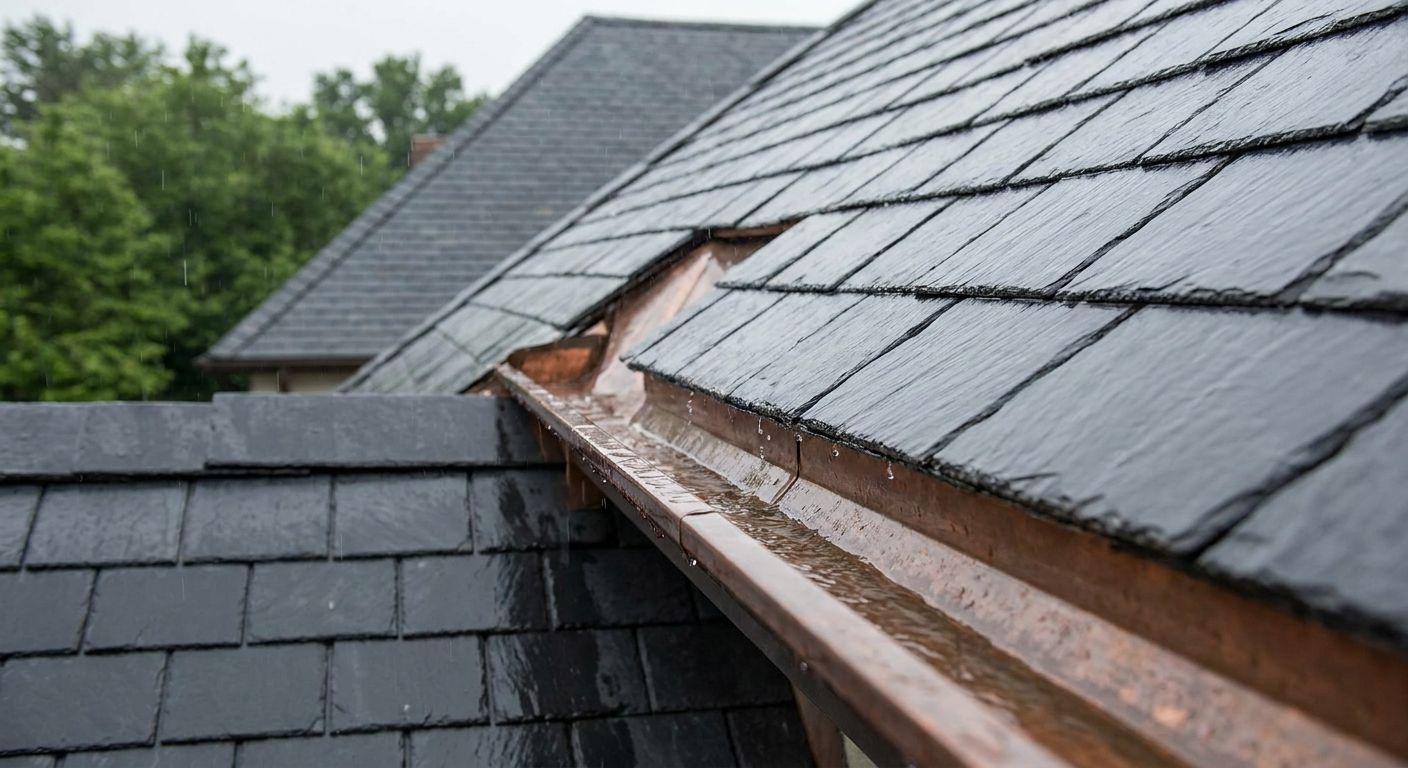
Copper doesn't rust, and it develops a protective patina over time instead of degrading the way galvanized steel eventually does. It's the material of choice on heritage restorations and higher-end custom builds where the gutter system is expected to last decades, not just outlast the roofing warranty.
Copper valley flashing pros:
- Corrosion resistance well beyond aluminum or steel
- Ages into a patina rather than deteriorating
- Common choice for heritage and character-home restorations
Copper valley flashing cons:
- Material and labor cost sit above aluminum or steel options
- Overkill on a standard tract-home reroof
Best for: Heritage homes and high-end custom builds. Verdict: Buy — if the budget supports it.
4. Galvanized steel valley gutter: best valley gutters for heavy snow load regions
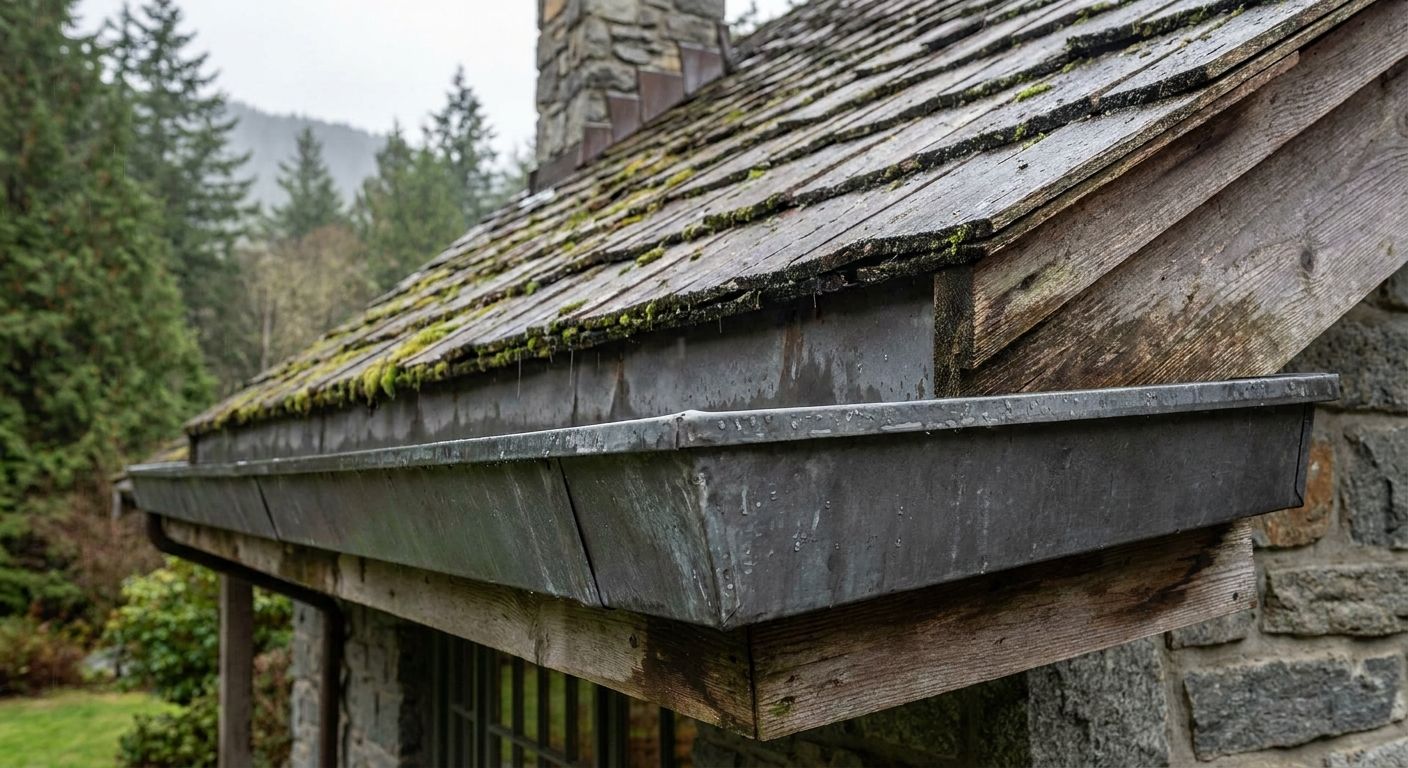
Steel is stiffer than aluminum, which matters when a valley has to carry the weight of compacted snow and ice through a BC interior winter. It's a heavier install and needs a solid galvanized or coated finish to avoid rust, but the rigidity holds up where aluminum would deform.
Galvanized steel pros:
- Higher load capacity under snow and ice than aluminum
- More rigid, resists sagging on long valley runs
Galvanized steel cons:
- Heavier to install, adds labor time
- Coating failure exposes bare steel to rust
Best for: Interior BC properties with heavy seasonal snowfall. Verdict: Buy for snow-load regions, Skip for coastal-only properties.
5. Standard sectional aluminum valley gutter: budget valley gutters option
Sectional gutters are joined in shorter lengths with connectors, which is cheaper to source and install but stacks up seams exactly where the water volume is highest. It's the entry point for anyone prioritizing upfront cost over long-term leak resistance.
Sectional aluminum pros:
- Lowest material cost of the five options
- Widely available, fast to source
Sectional aluminum cons:
- Every connector is a seam, and seams are where valley gutters fail first
- Higher long-term maintenance and re-caulking needs
Best for: Short-term budget projects or rental properties. Verdict: Hold — fine as a stopgap, not a long-term fix.
How we ranked
The order above tracks directly to seam count, material corrosion resistance, and load capacity — the same three factors that separate a valley gutter that lasts fifteen years from one that's leaking by year three. Seamless aluminum tops the list because it minimizes the single biggest failure point (seams) for the widest range of standard roofs, with material-specific picks slotted in for the roofs and climates where a different system genuinely performs better.
Debris buildup complicates all five systems equally. A valley that collects leaves and needle debris from two roof slopes clogs faster than a straight run, and once water backs up behind that debris it finds the nearest seam or flashing gap. Anyone weighing whether gutter guards are worth it on a BC roof should factor in that valleys are usually the first place debris collects, regardless of which gutter material sits underneath.
Get your valley gutters assessed
A site visit tells you which valley gutter system fits your roof and climate zone.
Which valley gutters should you choose?
For a typical BC residential roof, seamless aluminum K-Style with reinforced valley flashing is the default answer in 2026 — fewest seams, proven install method, and correctly matched to standard roof pitch. Move to EPDM-lined box gutters only if the valley in question sits on a low-slope or flat commercial section. Choose copper only when the project budget and the building's character justify the added cost. Choose galvanized steel when the property sits in a heavy snow load zone and rigidity under weight matters more than material cost. Sectional aluminum stays a stopgap, not a long-term system.
FAQ
What are valley gutters?
Valley gutters are the gutter or flashing systems installed where two roof slopes meet, channeling the combined runoff from both slopes into the drainage system. They carry more water volume per foot than a standard straight gutter run.
What's the best valley gutter system for a BC home?
Seamless aluminum K-Style with reinforced valley flashing is the best option for most standard-slope residential roofs in British Columbia in 2026. It minimizes seams, which is the main leak point in any valley gutter system.
Are copper valley gutters worth the extra cost?
Copper valley flashing resists corrosion longer than aluminum or galvanized steel and develops a protective patina instead of degrading. It's worth the added cost on heritage homes and high-end builds where longevity matters more than upfront price.
Why do valley gutters leak more than straight runs?
Valley gutters collect water from two roof slopes at once, so they handle a higher volume than a straight gutter section. Any seam, flashing gap, or debris clog in that higher-volume path shows up as a leak faster than it would elsewhere on the roof.
Is a box valley gutter different from a K-Style valley gutter?
Yes — box valley gutters are typically membrane-lined (often EPDM) and used on low-slope or flat commercial roofs, while K-Style valley gutters are formed sheet-metal profiles used on standard-pitch residential roofs. The two solve for different roof geometries.
Do gutter guards help with valley gutter leaks?
Gutter guards reduce debris buildup in the valley, which is often the trigger for a backup that finds a seam or flashing gap. They don't fix a poorly flashed valley, but they reduce one major cause of valley clogs.
How often should valley gutters be inspected?
Valley gutters should be checked at least once before the wet season and once after, since they collect debris from two roof slopes and clog faster than straight runs. Homes near conifers or heavy leaf cover need more frequent checks.
Can a sectional gutter be used at a roof valley?
Sectional aluminum gutters can be used at a valley, but every connector joint is a potential leak point in the exact spot carrying the most water. It's a workable budget option but not the most leak-resistant choice for a long-term install.
One last thing
Most valley gutter failures homeowners call about in 2026 aren't the gutter material at all — they're a flashing detail installed a size too small twenty years ago, now finally overwhelmed by a roof that's shed more debris than it did when it was new. Before replacing the gutter, check the flashing underneath first; it's often the cheaper fix and the actual source of the leak.