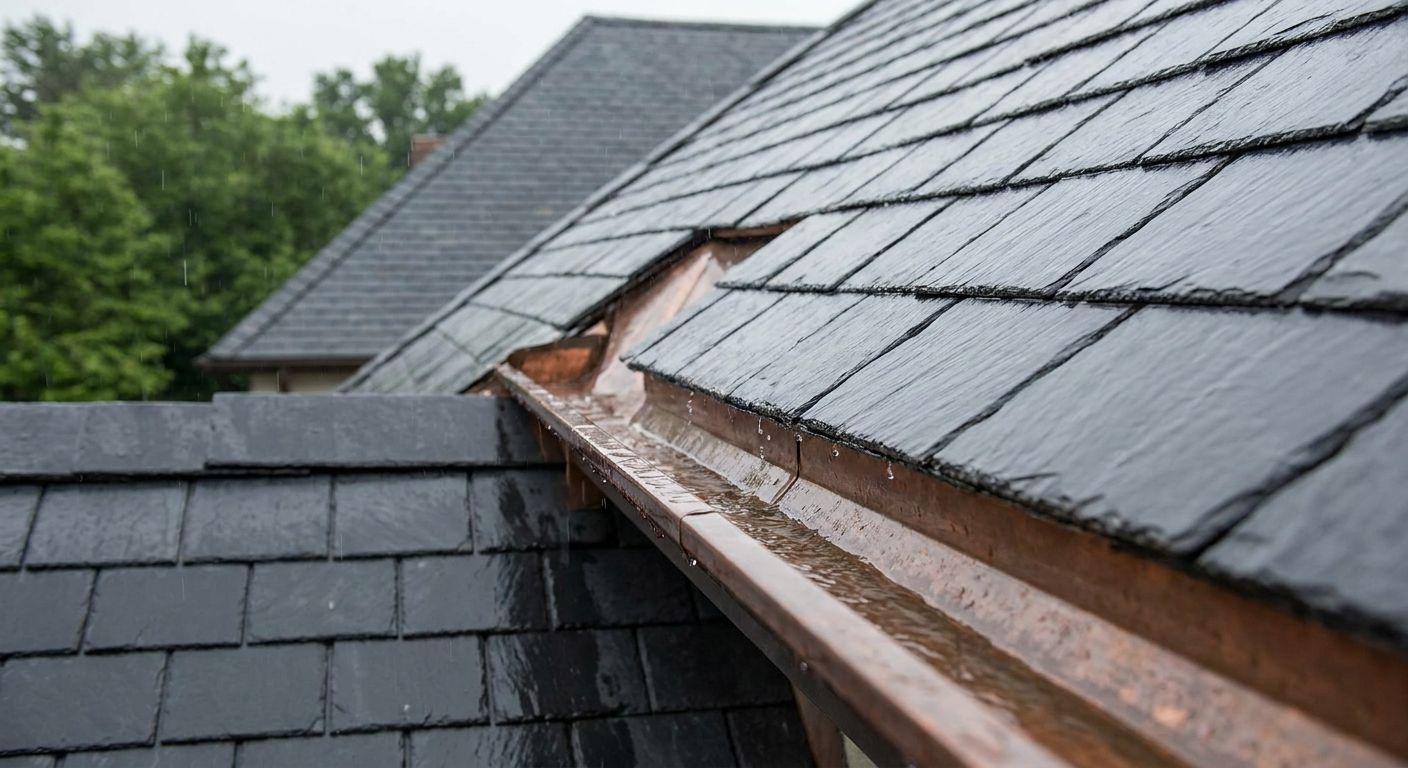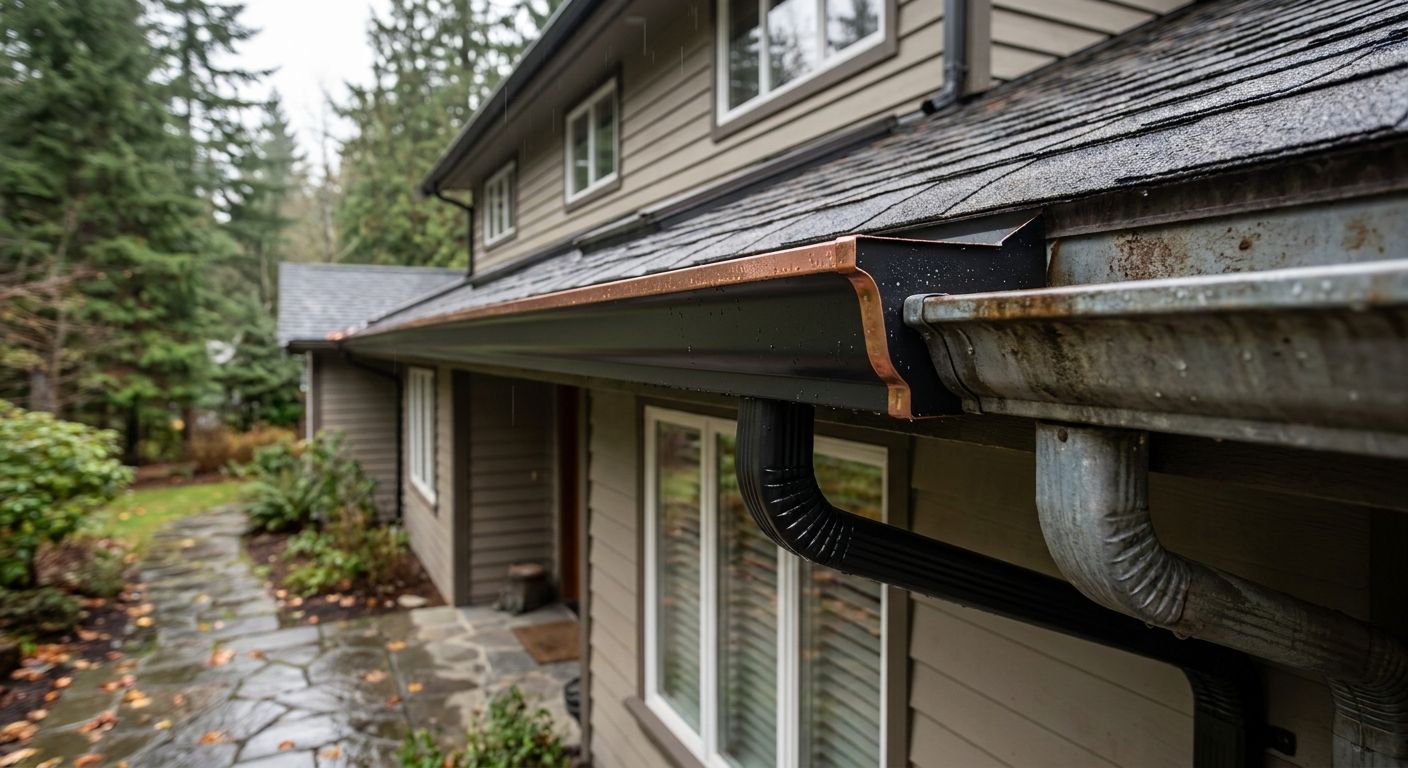
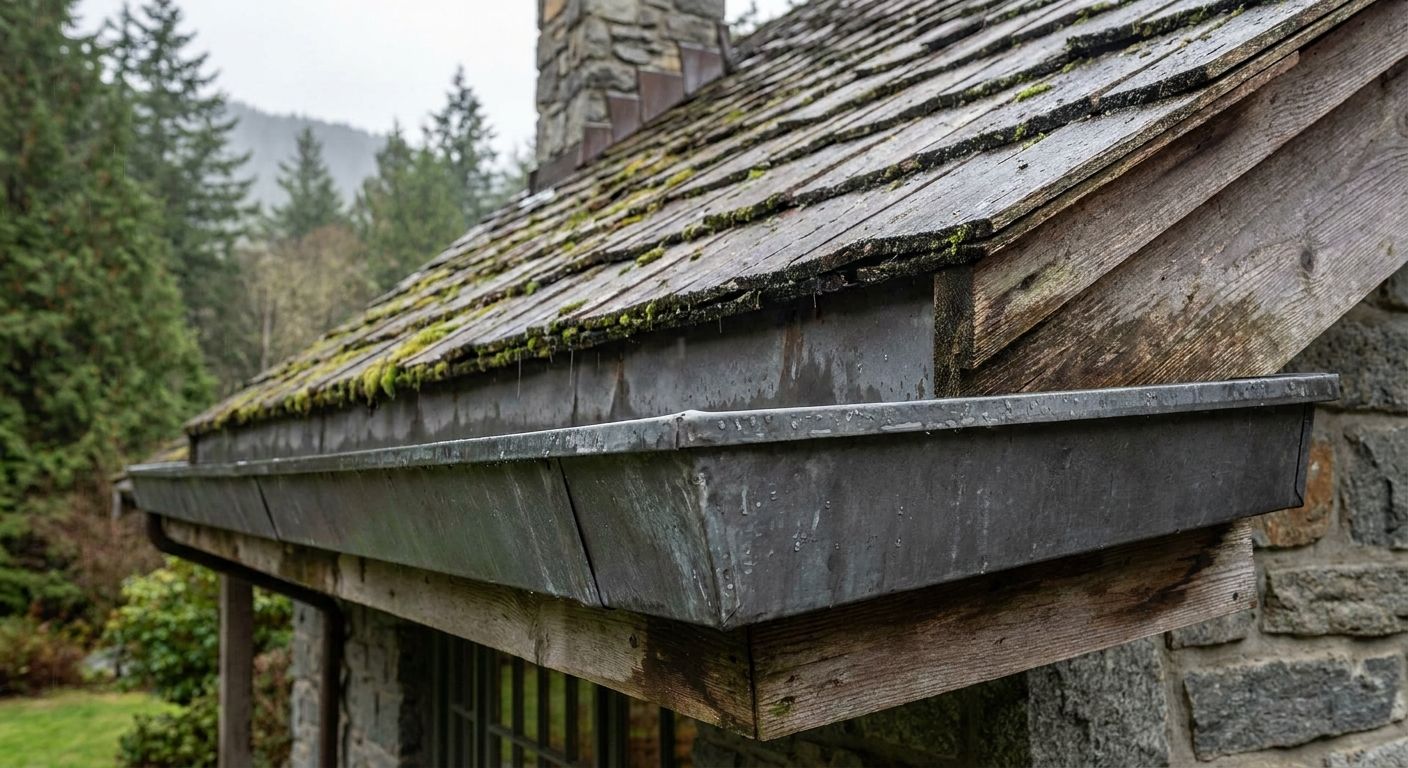
Box gutters built into century-old BC rooflines fail for one reason more than any other: the wrong material went in on a system that has almost no room for water to escape once it clogs. Best overall for durability: copper box gutters. Best for flat and low-slope retrofits: EPDM-lined box gutters. Best value pick for standard older homes: galvanized steel box gutters.
- Copper box gutter systems outlast every other material and are the right call for heritage BC homes built before the 1950s.
- EPDM-lined box gutters solve flat and low-slope retrofit jobs where soldered seams aren't practical.
- Galvanized steel box gutters give standard older homes 15-20 years of service at a fraction of copper's cost.
- Aluminum liners work for lightweight budget retrofits but corrode faster near coastal BC air.
- PVC liners are a stopgap only — skip them for anything you plan to keep past 2030.
Why this matters
A box gutter isn't bolted on like a K-style gutter — it's built into the roof edge, tucked behind fascia and framed as part of the structure. That's standard on homes built through the 1960s across Vancouver, Victoria, and New Westminster. When it clogs or the seams fail, water doesn't drip onto your lawn. It backs up under the roof deck and into the fascia and soffit cavity, where nobody sees the rot until the wood is soft.
BC gets roughly 1,200mm of rain a year in the Lower Mainland, more on the coast, and that volume finds every weak seam in a box gutter within a season or two. Talking to true gutter professionals before picking a replacement material matters more here than it does for a standard hung gutter, because a box gutter mistake is buried in the roof structure, not hanging in plain sight.
This ranking covers the five materials actually used in box gutter replacement and relining work on older BC homes in 2026, ordered by how long each one holds up before it needs attention again.
What makes the best box gutter system
- Material longevity — how many years before the metal or membrane fails outright
- Seam integrity — soldered seams outlast riveted or lapped ones on a box gutter specifically, because there's no slope to shed standing water off a weak joint
- Compatibility with older framing — some materials conform to irregular, decades-old roof edges better than others
- Weather resistance — freeze-thaw cycling and coastal salt air punish some metals faster than others
- Maintenance load — how often the system needs cleaning or inspection to avoid backup
- Repairability — whether a failed section can be patched or the whole run has to come out
Box gutters at a glance
| Material | Best for | Standout feature | Key limitation |
|---|---|---|---|
| Copper | Heritage BC homes | 50+ year lifespan, solder-sealed seams | Highest material cost |
| EPDM-lined | Flat/low-slope retrofits | Membrane conforms to irregular decks | Needs UV-stable membrane, not a metal fix |
| Galvanized steel | Standard older home replacement | Strong value-to-durability ratio | Coating wears through eventually, then rusts |
| Aluminum | Lightweight budget retrofit | Won't rust, easy to fabricate on site | Dents and corrodes faster near salt air |
| PVC/vinyl | Short-term patch jobs | Lowest upfront cost | Becomes brittle, shortest lifespan of the five |
1. Copper box gutters: best box gutter for heritage BC homes
Copper box gutters are formed and soldered on site, which is exactly what a century-old roofline with irregular angles needs. The seams are sweated rather than riveted, so there's no mechanical joint for water to work loose over time. Copper also develops a patina that actually protects the surface instead of degrading it.
Copper box gutter pros:
- Soldered seams hold up longer than any mechanical joint
- Conforms to irregular, decades-old roof edges without gaps
- Patina layer resists further corrosion instead of accelerating it
Copper box gutter cons:
- Highest material and labour cost of the five options
- Requires a fabricator comfortable with soldering, not every crew is
- Overkill for a home you don't plan to keep past 10-15 years
Copper box gutter verdict: Buy — if the home is a heritage property or you're keeping it long-term, copper is the only material on this list built to outlast the roof itself.
2. EPDM-lined box gutters: best box gutter for flat and low-slope retrofits
When a box gutter sits under a flat or low-slope roof section, a rubber EPDM membrane liner solves problems metal can't. It flexes with the deck, seals without soldering, and handles standing water better than any rigid material on a run with almost no pitch.
EPDM-lined box gutter pros:
- Flexes with irregular or settling roof decks
- No soldered seams to fail over decades
- Handles standing water on near-flat runs without pooling damage
EPDM-lined box gutter cons:
- Membrane needs UV-stable material or it degrades faster in direct sun
- Not a fix for a fundamentally undersized box gutter
- Punctures from debris or foot traffic need prompt patching
EPDM-lined box gutter verdict: Buy — for flat or low-slope sections where a metal box gutter would need custom soldering anyway, EPDM is the practical retrofit call.
3. Galvanized steel box gutters: best box gutter for standard older home replacement
Galvanized steel is the workhorse choice for a standard 1940s-1970s BC home that doesn't need heritage-grade copper. The zinc coating protects the steel underneath until it wears thin, typically giving 15-20 years before rust sets in at the seams.
Galvanized steel box gutter pros:
- Strong durability-to-cost ratio for a standard replacement
- Rigid enough to hold shape on straight roof runs
- Widely available, most gutter crews can fabricate and install it
Galvanized steel box gutter cons:
- Zinc coating wears through eventually, then rust starts at the seams
- Heavier than aluminum, adds weight to the fascia connection
- Repairs after coating failure often mean a full section replacement
Galvanized steel box gutter verdict: Buy — the right default for a standard older home replacement when copper's cost isn't justified.
4. Aluminum box gutter liners: best box gutter for lightweight budget retrofits
Aluminum won't rust, which makes it appealing next to a rusting galvanized steel run. It's also lighter, easier to fabricate and lift into place on a retrofit job where the existing fascia can't take much added weight. Coastal salt air is its weak point, corroding aluminum faster than it corrodes copper or properly coated steel.
Aluminum box gutter pros:
- Won't rust like uncoated or worn galvanized steel
- Lighter weight, easier retrofit into existing fascia
- Lower material cost than copper
Aluminum box gutter cons:
- Dents more easily than steel or copper
- Corrodes faster in coastal salt air than inland installs
- Shorter lifespan than copper or well-maintained steel
Aluminum box gutter verdict: Hold — fine for a budget-driven retrofit inland, but weigh the corrosion risk before installing near the coast.
5. PVC/vinyl box gutter liners: best box gutter for short-term patch jobs
PVC and vinyl liners are the cheapest way to stop an active leak today. They're not a long-term box gutter solution on an older BC home — the material becomes brittle with UV exposure and temperature swings, and once it cracks, water finds the same fascia and soffit damage the liner was meant to prevent.
PVC box gutter pros:
- Lowest upfront material cost
- Fast to install as a temporary fix
- Useful for stopping an active leak before a full replacement
PVC box gutter cons:
- Becomes brittle and cracks with UV and freeze-thaw exposure
- Shortest lifespan of any material on this list
- Not a viable long-term system for a heritage or long-hold property
PVC box gutter verdict: Skip — unless you need an immediate stopgap before a proper replacement, this material buys you a year or two, not a decade.
Get a box gutter assessment
Find out which material fits your roofline before you replace anything.
How we ranked
The order above weighs material lifespan first, since a box gutter failure is a structural repair, not just a gutter repair. Seam integrity and compatibility with older, irregular roof framing come next, followed by how each material handles BC's rain volume and coastal weather. Maintenance load and repairability broke the remaining ties.
Which box gutter should you choose?
Copper is the right call for a heritage BC home you're keeping long-term — the soldered-seam lifespan justifies the cost. If the box gutter sits on a flat or low-slope section, EPDM lining solves what metal can't. For a standard older home replacement without heritage status, galvanized steel is the sensible default on durability per dollar. Aluminum earns a place only when weight or coastal budget constraints rule out steel, and PVC belongs strictly in the stopgap category until proper work gets scheduled.
Before signing off on any of these, get someone to look at the fascia and soffit condition behind the existing box gutter — a new gutter system installed over rotted framing fails regardless of the material picked.
FAQ
What is a box gutter?
A box gutter is a gutter system built directly into the roof edge structure rather than hung on brackets under the fascia. It's common on BC homes built before the 1970s and requires different repair and replacement methods than a standard K-style gutter.
How long do box gutters last?
Copper box gutters last 50 or more years with soldered seams, galvanized steel typically holds up 15-20 years, and PVC liners last 10-15 years before becoming brittle. Lifespan depends heavily on seam quality and exposure to coastal salt air in BC.
Are box gutters more expensive than regular gutters?
Yes, box gutters generally cost more to install or repair than standard hung gutters because they're integrated into the roof structure and often require custom fabrication and soldering rather than off-the-shelf sections.
Can you repair a box gutter instead of replacing it?
Often yes, if the failure is limited to a section or an outlet rather than the seams throughout the run. A patch or outlet replacement can extend the life of an otherwise sound box gutter before a full replacement is needed.
What causes box gutters to leak?
Most box gutter leaks start at the outlet or a failed seam, not along the flat run itself. Debris buildup that traps standing water accelerates seam failure regardless of the material.
Is copper better than aluminum for a box gutter?
Copper outlasts aluminum by decades because its soldered seams don't fail the way mechanical or lapped joints do, and its patina resists corrosion better than aluminum near coastal BC air. Aluminum costs less upfront but needs replacement sooner.
Do box gutters need special maintenance?
Yes, box gutters need more frequent debris clearing than hung gutters because a clog backs water up into the roof structure instead of overflowing visibly onto the ground. Inspecting the outlet and seams each fall catches problems before they reach the fascia.
Can EPDM be used to reline an old box gutter?
Yes, EPDM rubber membrane is a standard relining option for flat or low-slope box gutter sections where soldered metal seams aren't practical. It conforms to irregular or settled roof decks better than rigid metal.
One last thing
Most box gutter failures on older BC homes start at the outlet, not along the seams everyone worries about. An outlet replacement is a fraction of the cost of a full box gutter replacement, and catching a failing outlet before it backs up water into the fascia is the single cheapest thing you can do to extend any of the five materials ranked above. Whatever material you choose in 2026, that's the spot worth checking first every fall.
For a deeper look at whether add-on protection makes sense alongside a box gutter replacement, see are gutter guards worth it for BC homeowners.